

Stained Glass Style Guide
This stained glass style guide "Art Glass Inspiration", is meant to offer ideas and inspiration for new glass design.
Included are a collection of windows created in a wide variety of styles, and various types of glass. There are many diverse styles of design, colors and methods of creating with glass available for consideration to reach the final look and feel of a completed body of work. Once the direction of your project is established, the combination of color, texture, and light plays a major role in determining how successful the outcome of the stained glass, faceted or Leptat®-etched window will be.

The following window images are broken into six basic categories; Traditional, Patterned, Contemporary, Tiffany Style, Faceted and Leptat®-etched. These are an aid only as a starting point in that decision for the style of glass which might best fit the needs of the individual environment which will house them. These examples offer a glimpse of the options available when envisioning your new stained glass project. Variations are infinite and the creativity is limited only by your imagination

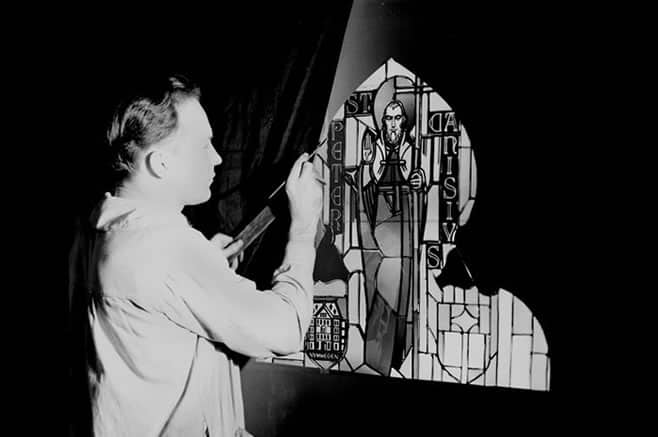
Traditional-styled stained glass is often
heavily painted, conveying biblical scenes
from the life of Christ and complimenting
more classically-styled architecture.

repeating shapes, sizes and colors that present symmetry in multiple windows and allows for a lower cost of production.
Patterned stained glass is designed with

Contemporary stained glass is often
less painted, using larger bold-colored
glass and is more abstract in design.

Tiffany-styled stained glass often
contains intricately cut opaque
or opalescent glass, overlaid with
wide varieties in thickness.

Faceted glass, or dalle de verre employs
thick slabs of colored glass, set into epoxy
rather than lead cames. Its appearance often is
reminiscent of mosaic, but the glass glows
with light-filled color.
Leptat® art glass is the signature etched glass
of CSS, which creates a deeply etched, crystalline
surface of varied textures. Leptat® is often used as a
partition between adjoining areas.
Additional pages featuring The Stained Glass Style Guide
are currently being developed by the CSS Team.
Please check back soon for the updated pages and supporting images.
![]()
![]()
